
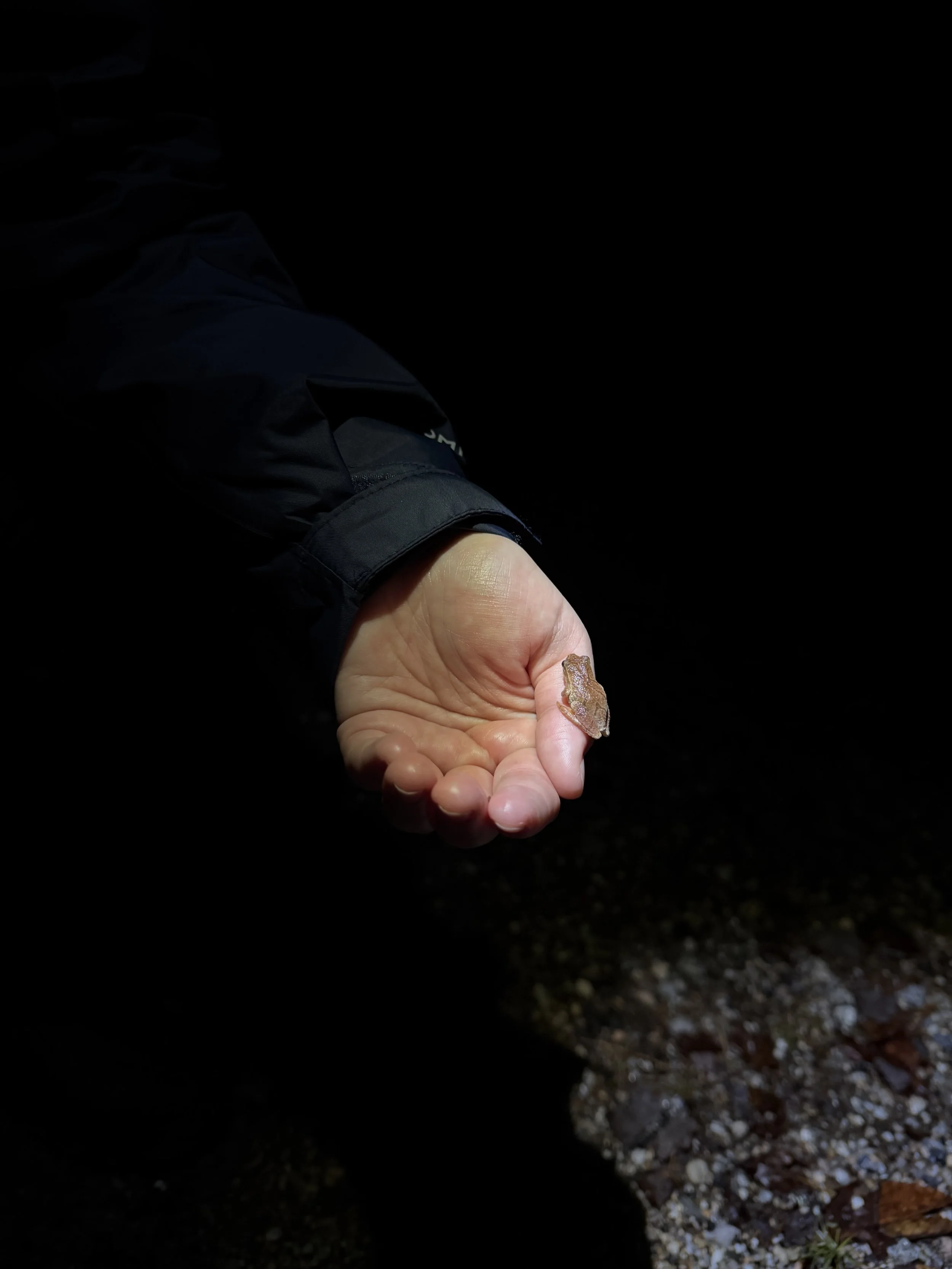
As a child, I grew up in populated suburbs with little green space. Critters were few and far between – a roly poly hiding between sidewalk cracks, a deer munching on perfectly mowed lawn, maybe even a rare red fox in the early hours of the morning. Safe to say, when I learned about Big Night (an amphibian road crossing event), I was ecstatic: here was an opportunity to help critters I would have loved to see as a kid.
When I imagined Big Night, I imagined the frogs and salamanders as, well . . . big. I expected the miniscule peepers, easily plucking them off the pavement one-handed that wet April night, but I was impatiently waiting for the stars of the show to appear: salamanders. As my co-AmeriCorps, Rose, and I shuffled along in the dark, I gingerly tip-toed around bright worm-shaped lines on the ground, warning Rose as I went. I was several feet ahead of them when they exclaimed, “How could you miss all of these?” Turning back, amused that Rose was mistaking worms for the mighty salamander, my feelings quickly turned to confusion as they pointed to the tiny mass on the road that was undoubtedly not a worm, but an Eastern red-backed salamander. How could this critter, barely longer than my pointer finger and skinny as pencil lead, make up the majority of forest biomass?
A small seed of disappointment bloomed in me as I shuttled the little wriggling guy across the road, and I was briefly reminded of my first time in the field sampling for my organization's RIVERS program, which monitors the water quality of tributaries in the Saco watershed. Based on the name, I imagined jumping into a raging river like the dirty, wide Potomac of my home to collect data. When my supervisor, Jill, led me to Square Brook, a creek barely wider than me, I almost laughed in their face – until I saw her pull out the equipment and get to work.
I grappled with minor feelings of disappointment as the first few months of my service got underway. Used to working in the sweeping expanse of the Chesapeake Bay where most environmental work was an uphill battle for a struggling ecosystem, I didn’t see the point of monitoring practically pristine waters. It wasn’t until I attended a webinar for winter salt week that my feelings changed. Run by researchers at Virginia Tech, I was shocked to see their water and road salt studies focused on the Occoquan River, a place I rowed in high school. I was even more shocked to learn that salinity got so high in some areas that a water treatment plant had to shut down briefly. As the researchers talked about the sources of road salt feeding into the Occoquan, my mind trickled back to Square Brook, following its path to the Ossipee, the Saco, and eventually the Atlantic Ocean. The puzzle pieces I had been shuffling around in my head finally clicked into place, and I returned to winter sampling with renewed fervor.
A similar journey took place in the dark as I came across one or two, then five, then more than ten red-backed salamanders. All of them were making their way to their breeding ground, propelled by their own river of instinct: brooks and streams flowing unrelentingly to their own ocean. Without fail, they will continue to do so for the rest of our lifetime and beyond. They’re a small piece making up the complex web of ecosystem health, similar to the streams and brooks I now fondly sample. And a tiny blip in my life, whether spent ushering critters across a road or sampling in the shallows, can help their environment in ways I can’t even imagine.
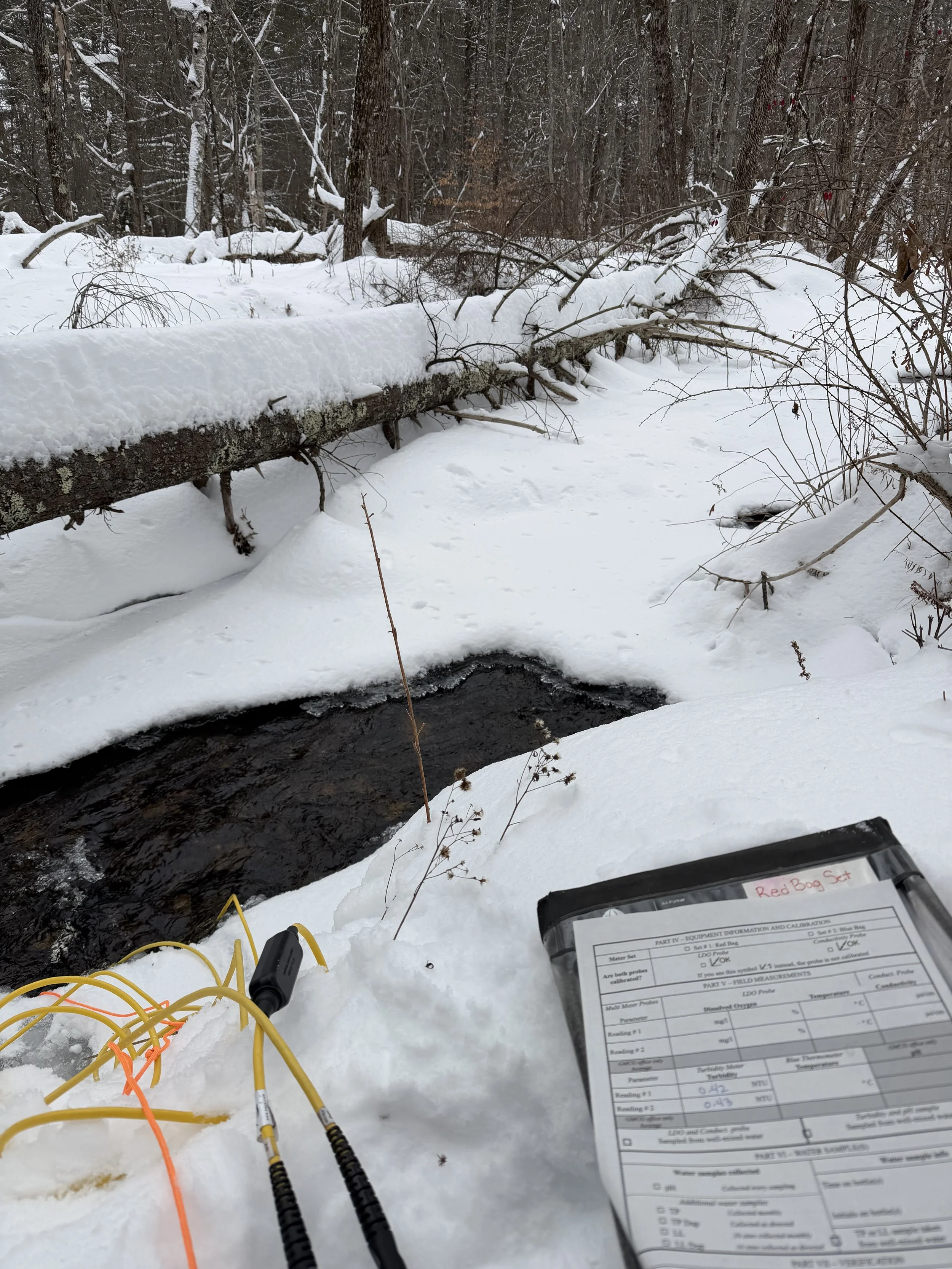
A typical view during winter RIVERS sampling.
Cass is serving with Green Mountain Conservation Group as their Water Quality Resource Assistant. With a background in marine biology, you can often find them around or in bodies of water, either for fieldwork or for fun. Outside of serving, they like reading, birdwatching, traveling and exploring, and watching reality TV with their fellow AmeriCorps member. Learn more about them here.