
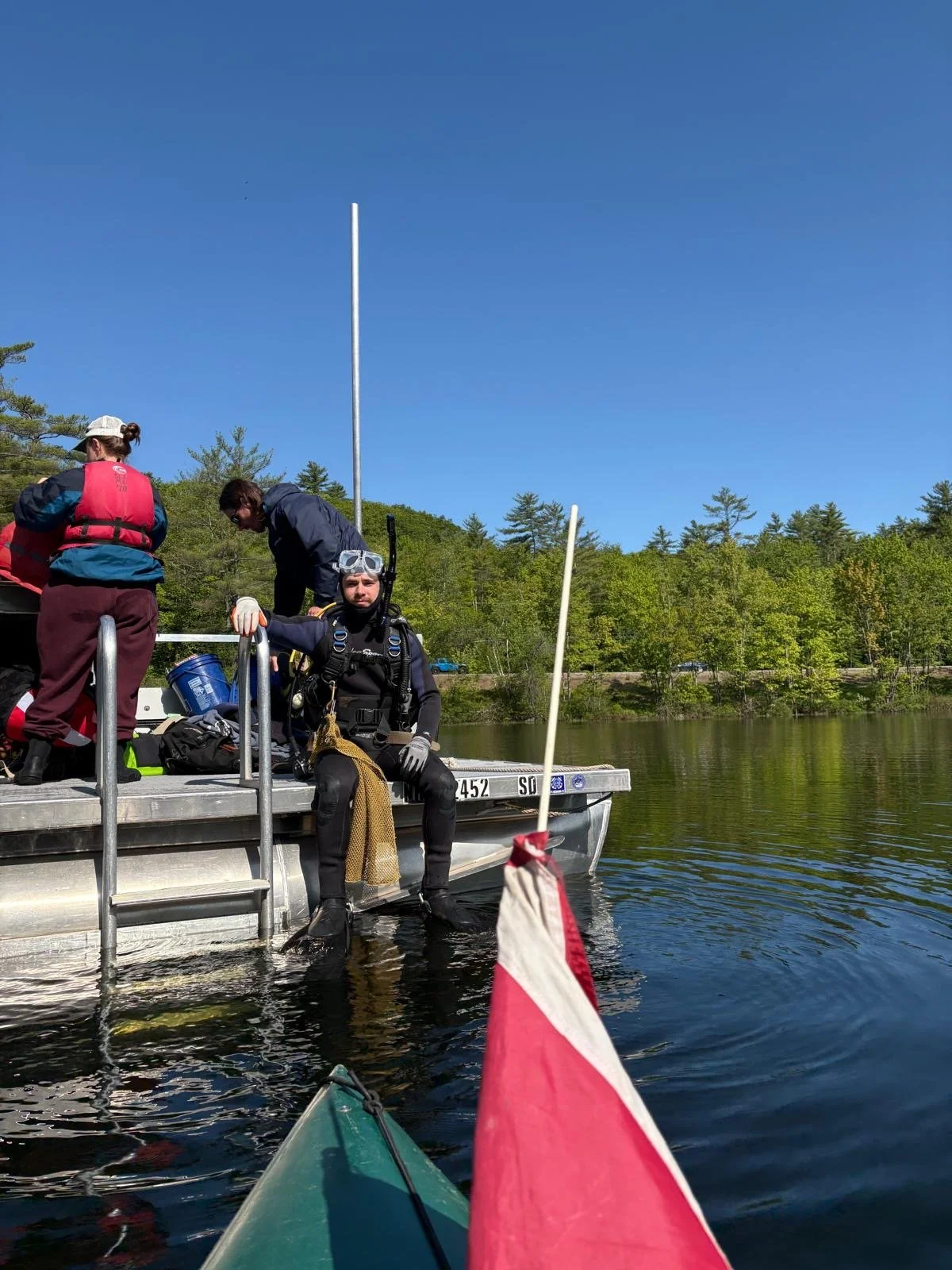
I sat on the edge of our dive boat - affectionately named Millie - with my legs dangling over the water. It was sometime in early August, and it was hot outside. Hot hot. We were parked in a cove on the Squam River. While we’re scuba diving to remove variable milfoil, we operate in a three person rotation. One person suits up and goes under to pull plants, another person hovers above the diver in a kayak, making sure the diver is safe and scooping up floating milfoil fragments, and a third person hangs out on the boat, packing harvested milfoil into twenty gallon containers. Each hour we rotate duties. So, I was person three for the moment.
As I recuperated from my dive and warmed under the oppressive UV’s, a woman and a man kayaked up to the boat. The woman started asking me about what we were doing. I love any chance to tell people about conservation, so there I went. I explained that variable milfoil is an aquatic invasive species in Squam (one of two, the other being mystery snails) and other New England lakes. It is bright neon green, grows quite tall, and resembles something like a long squirrel's tail, or a skinny christmas tree. It forms these dense mats that choke out native species, plants and fish alike. It also harms recreation, making swimming unpleasant or ruining it completely, clogging up boat engines, etc. I told them it was first discovered in Squam in 2000, and for the better part of these last two decades, the Squam Lakes Association has been managing the infestation by handpulling with scuba divers, or by using our DASH system, which is a giant vacuum hose that helps suck the plants right up to the boat and helps us move faster through the nastier patches. Then the woman hit me with a whammy of a question.
“So, if you’ve been pulling milfoil for many years, and still just keeps growing, then why go through the trouble of continuing to try to get rid of it?”
A valid question, but one that we have an answer for.
First we need some context, so let’s answer another question that's often posed to folks in the conservation field: What makes a species invasive? Well, it has to meet a few criteria. First, the species has to be from somewhere else, or “non-native.” It should be noted that there are many non-native species that aren’t considered invasive in New Hampshire, like largemouth bass. Second, a species has to cause a negative effect, whether that be ecologically, recreationally or economically. And third, the species has to grow prolifically and outcompete native species for resources. These last two points kind of go hand-in-hand. Native ecosystems comprise species that have evolved alongside each other for millions of years. They are optimized to coexist, so that each species provides checks and balances for each other, and no single species grows out of control. When a non-native plant gets thrown in, it typically has no predators to counter its growth, and if they’re wired to grow faster than a native plant (like many invasives are), then they can consume resources faster, completely unchecked, and grow, and grow, and grow. The ultimate fear is that an invasive species could kill off natives and create a monoculture, where everything is just itself.
In our case, variable milfoil hails from the southeast and midwest United States. In ideal conditions, it’s said that it can grow up to one inch per day. It has no natural predators here and also spreads in a number of ways: budding above the surface to produce seeds, growing advantageous roots on old, drooping stems; sending rhizomes under the silt to sprout new stalks elsewhere; and fragmentation. Fragmentation is arguably the biggest concern for Squam. As boat propellers chop up sections of the plant and carry them around the lake, those sections can float back down to the bottom and begin growing a new plant.
So to answer the question from the woman on the kayak: Once an invasive species gets introduced somewhere, it is near impossible to eradicate it completely. There is so much ground to cover that you can do everything humanely possible to clear out an area, but odds are that you’re going to miss one little bit, and that’s just going to sprout and start growing again. This does not mean that we should just lay down and give up. The next best option after eradication (which sadly, isn’t really an option until some wicked-smart research scientists come up with a groundbreaking solution) is management; understanding that even if this plant is here to stay, we can mitigate its effects on our local economy, recreation and the environment. For us, all that takes is air tanks and elbow grease.
I’m going to let you in on some trade secrets, and warning, it’s illegal to remove variable milfoil or other invasive species without a “Weed Control Diver” certification and permission from personnel at NHDES. So please, do not attempt without the proper credentials.
When LRCC go scuba diving in Squam, we are either surveying for variable milfoil, handpulling it, or handpulling it with our help from our DASH system. On surveying missions, we’re swimming around just looking for milfoil, and it’s swell when we don’t find any. When we do find it, and it’s popping up in smaller, dispersed clumps between native plants, we get to hand pulling, which is more of a precise approach. In one hand, we hold a mesh dive bag and the handle to our dive flag. Somehow, we still manage to use that full hand to trace the thick, red stem down to the milfoil’s roots, and pinch. Then use our free hand to dig into the mud and find the “root ball.” I like to scoop around it with a cupping motion as I slowly lift the plant up by the stem. Then we have to wiggle our fingers around to shake silt off of the roots, before balling up the plant and tossing it into our bag. If you’re delicate enough, you can hold on to that plant and trace its rhizomes to the next one. Rhizomes are like sub-surface stems that branch off to grow new plants.
If, however, we find an extensive and dense patch of milfoil, we pull out the heavy duty stuff, aka, the DASH system. DASH stands for Diver Assisted Suction Harvester. It has a long and wide vacuum tube with a handle at the end that the diver brings with them underwater. The tube leads back up to the topside of the boat where it dumps water and milfoil onto a table that's full of holes, like a colander, which allows water and silt to drain back into the lake. Someone on the boat gathers the milfoil as it comes and then packs it into containers. The whole thing is powered by a little gas engine.
Contrary to popular belief, the divers don’t just stick the nozzle into the silt and slurp away as though we’re vacuuming the living room rug. The machine would instantly clog with mud and we wouldn’t be removing the plant’s roots that way, which need to come out or else it will just grow back again. Instead, we treat the DASH hose as a modified dive bag, continuing to hand pull from the roots and feeding the plants into the nozzle by hand. This eliminates the need for us to keep going up and down to trade full milfoil bags for empty ones, and generally allows us to deal with each individual plant much faster. When the DASH goes out, a 20-gallon day turns into a 200-gallon day (we measure milfoil harvest in gallons), or even 300. But the DASH hose is heavy, cumbersome, hungry for a diver’s gloves, and sometimes seems to conjure up its own colorful ideas about where you're going. If hand pulling is the scalpel, DASHing is the sledgehammer.
The reason why we have to dive in Squam is a shame, but I absolutely love it down there. Spending so many hours under the water has given me an entirely new perspective on the importance of our collective efforts to conserve the lakes. From gigantic bass jumping at you from under docks, to swimming past the base of boulders standing ten feet high, the schools of shiners circling over head like a flock of birds, pickerel striped like cats hovering still as a statue in the native grasses, bullhead catfish bumping into you like their blind, and tiny red mites swimming from plant to plant. It is another world. My AmeriCorps service has given me the opportunity to view conservation in a completely different way. It’s given me a fuller understanding of the ecosystems we’re trying to conserve and allowed me to help out the wonderful communities living on Squam and the visitors who cherish it too.
When you pull a plant too rough, too fast, a cloud of silt sheaths your vision in a brown plume. Visibility goes from feet to inches. And then a cloud of black clay follows close behind. Everything goes pitch black. Darker than a moonless night. You get the sensation that your face is too close to something - like you're up in the front of the classroom with your nose to the blackboard - and you start backing up. For a moment you forget where you are. You forget you’re even underwater. And then you remember. You move to the side to find some daylight. You take hold of the next plant, and trace it to its roots.
