
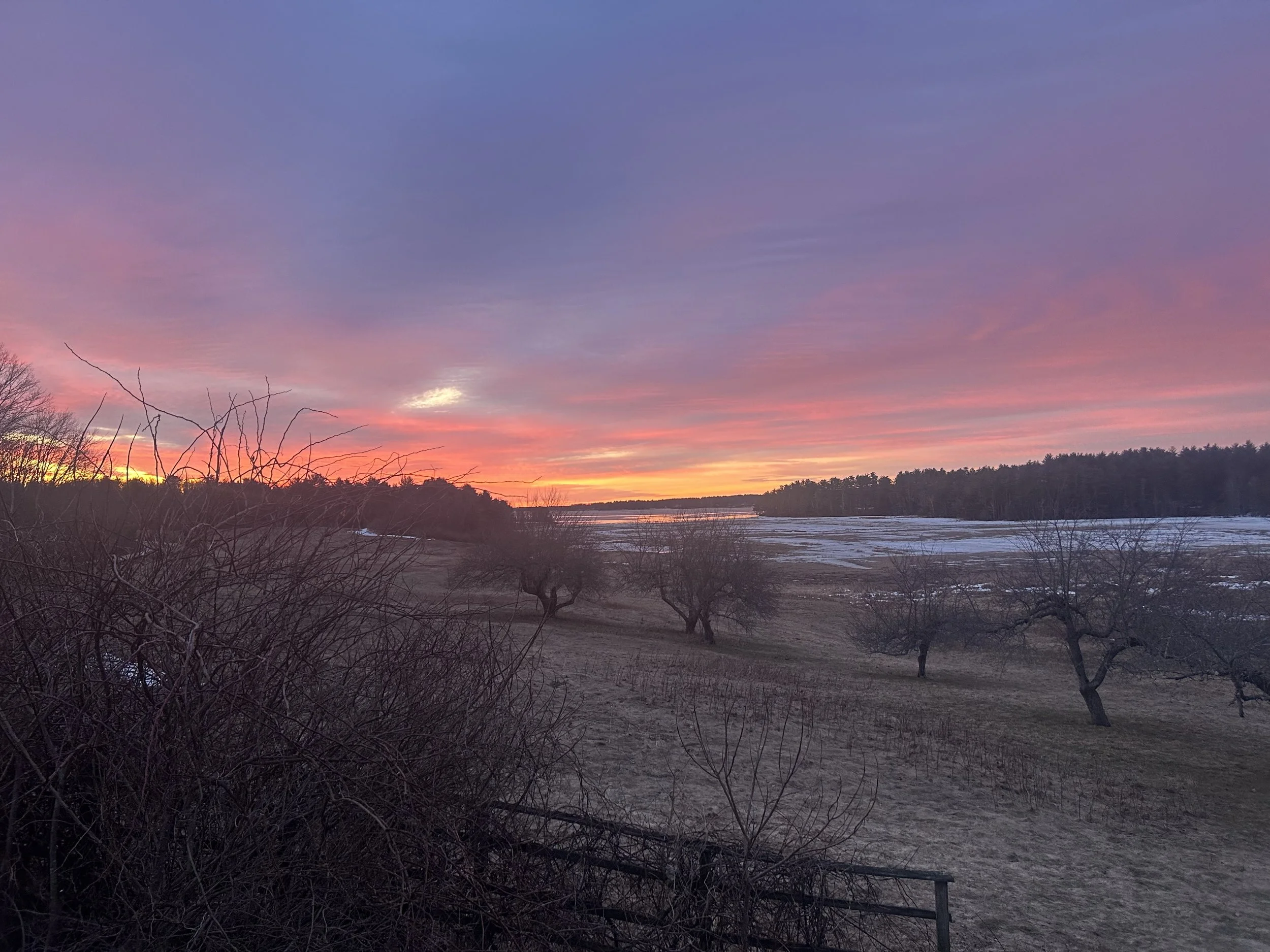
Follow the Orange Blazes
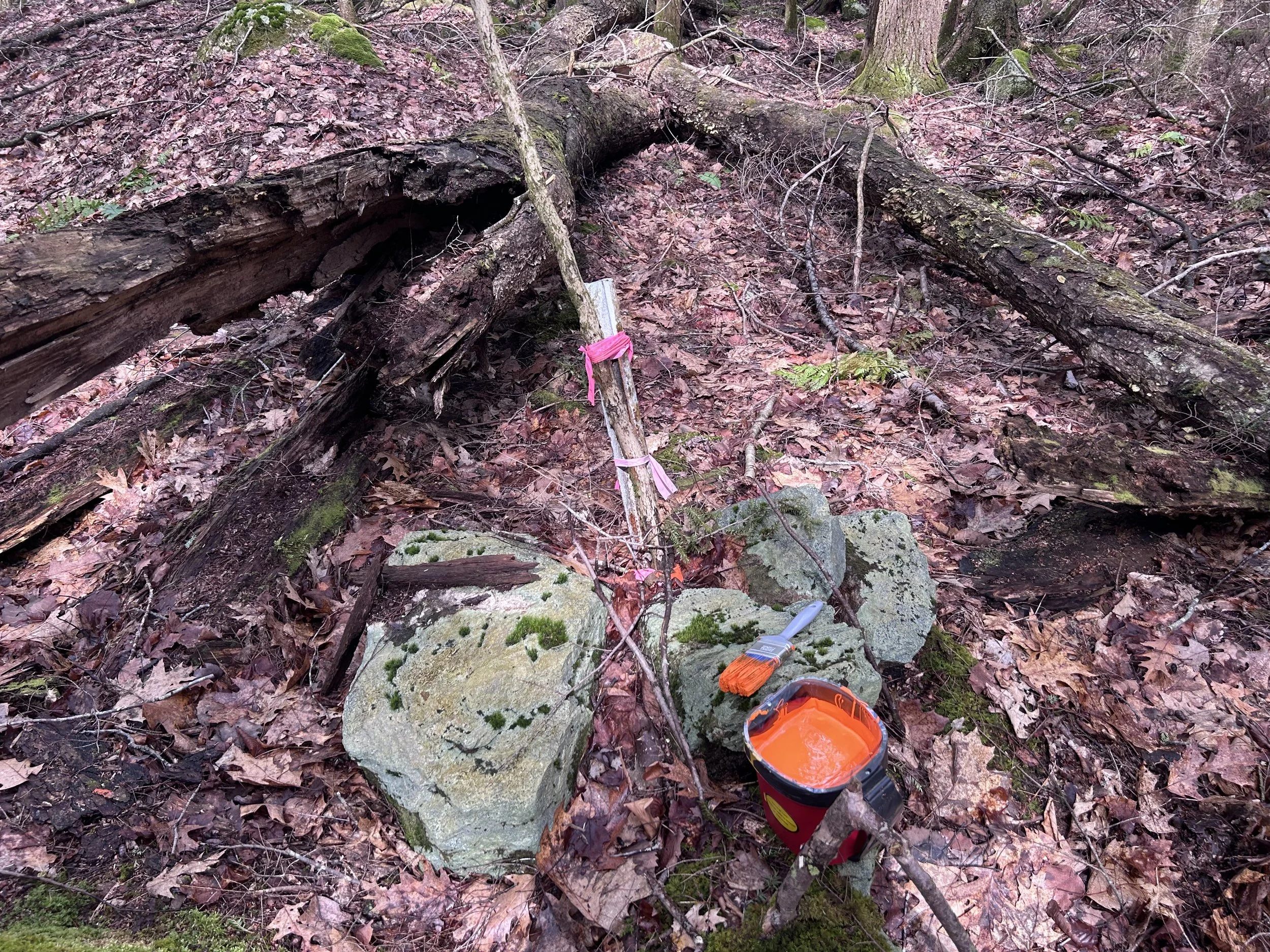
Orange. All I see is Cheeto colored orange on the trees as I look back at our boundary lines. My crew partner, Kylie, and I have been repainting our boundary lines at one of our western preserves. The trees definitely are not the only thing orange. Inevitably, my pants and shirt have been speckled with orange, too. Thankfully, we both thought ahead to wearing old clothes. Each of us holds an old yogurt container filled with Valspar StormCoat paint and a paintbrush in the other hand.
We continue to walk down the line, painting over old orange paint and blazes on the trees. Soon, we both stop, though. Looking down, we see the line abruptly drops off a ledge. “Guess we’ll just need some rappelling equipment,” I joke. We both decided to find a safer way down, walking further to a less steep slope to get back toward the line. It’s moments like this where I wonder how past people painted the line. Did they have climbing gear or just intentionally go uphill instead of down when painting the line?
It often feels like a Choose Your Own Adventure book when we are doing boundary work. We have bounced from hummock to hummock through Atlantic white cedar swamps, walked through thickets of bear oak to paint lines, and climbed many lines straight up-slope . The time at these preserves makes me appreciate their preciousness even more.
The same preserve with Cheeto colored paint was surveyed by a professional. They marked our boundary line with orange paint and created a survey plan for the area. Think of the survey plan as a detailed map of an area. It shows the boundary lines giving their length and compass bearing to the next corner. It also shows what physical monumentation is there marking your corners such as an iron pipe, granite bound, carsonite marker, etc. The most important piece of evidence to describe your land is the deed. A deed is a legally binding document between a granter and grantee describing the land you own (it should match up with the survey map drawn for the tract).
One important aspect of land stewardship is maintaining our boundaries, both for good relationships with neighbors and making sure that the policies for our preserves are being upheld. In an ideal world, all our preserves would have been professionally surveyed with a good amount of monumentation, so our boundary lines are clear. Monumentation can vary from blazes on trees (a long cut typically with an ax into the tree done by a professional surveyor), rebar, stone walls, old granite bounds, and more. However, depending on the preserve, the level of monumentation is very different.
I have found out how vastly different the boundaries are first hand. This was the first preserve Kylie and I went to do boundary work on. We went to check the tin squares (metal triangular signs marking our boundary) and corners for this tract, a more recent acquisition. We quickly realized there was no boundary line. We could find no tin squares or rebar/iron pipes marking the corners. The issue with tin squares being the only monumentation is if they fall down or are removed, the line is gone, versus blazes on trees or rebar. We hoped that when we got back to the office that the deed, or a survey would better explain the boundary lines. Turns out there was no survey for the tract, and the deed’s description was for an entirely different shape than what the town tax parcels showed. You can see in this worst case scenario why maintaining and monitoring our boundaries is so critical. In the case of this preserve it could be 4 acres or 12 acres that we actually own, who knows?
As Kylie and I continue to do boundary maintenance and monitoring, I am excited to think of how it will help with our and other people's understanding of these preserves in the future. I can see back 100 years ago and visualize an old homestead. People walking down the old forest roads hearing the hairy woodpeckers pecking at the oak trees. Seeing the trickle of the waterfalls, the mallards swimming in ponds. Then I think of today with red efts wiggling on the forest floor, trilliums budding, and turkey gobbling. Hopefully, by maintaining these boundaries, people can continue to see the importance of preserving these areas.
Round-leaved violet
Sprouts through the mossy rocks
Giving hints of spring
Erin is serving with The Nature Conservancy as an AmeriCorps Land Steward. She graduated from SUNY ESF with a degree in environmental studies. In 2025 she hiked the Appalachian Trail encouraging her to give back to the land. When not hiking she’s baking, reading, or gardening. Learn more about her here.